Neutron star pulsar
1344×768 · AVIF · CC BY 4.0
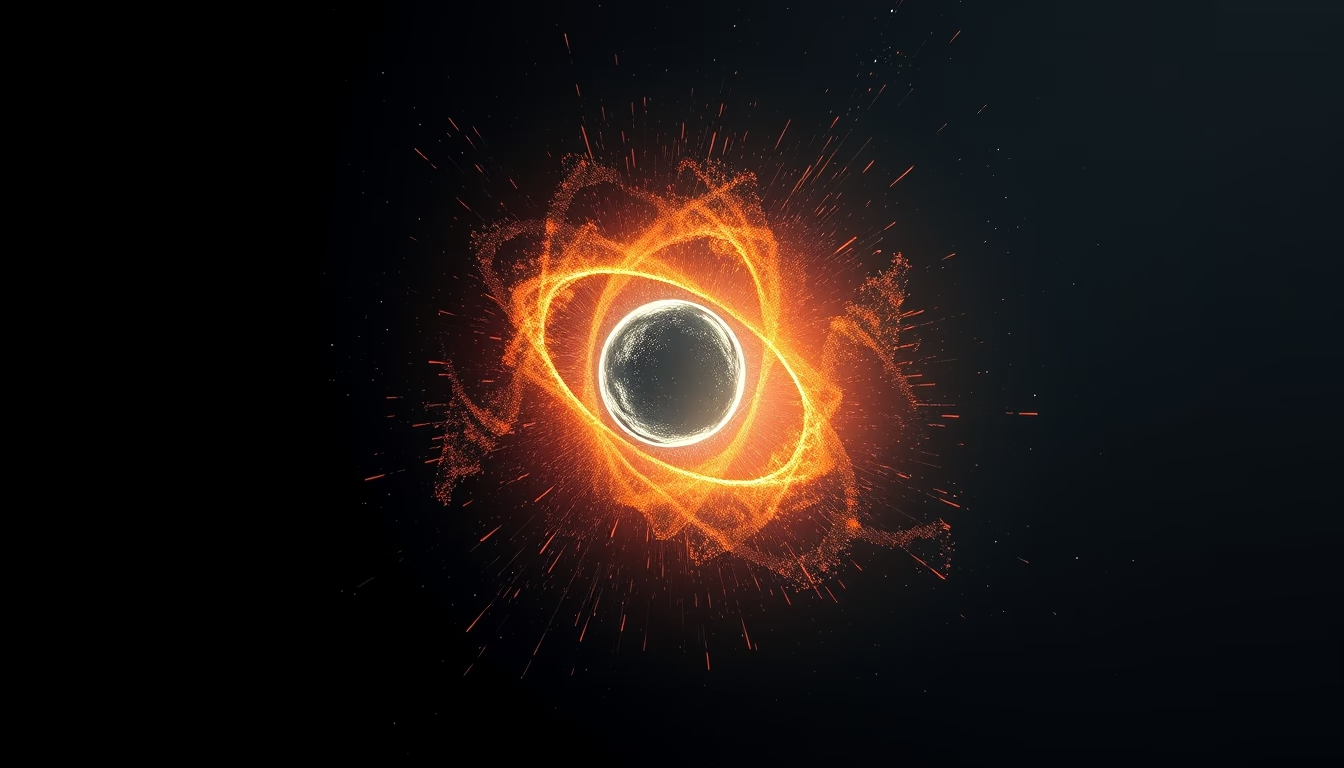
Pulsars are neutron stars that emit regular beams of radiation like cosmic lighthouses, revealing extreme physics phenomena.
About this subject
Pulsars are highly magnetized neutron stars that rotate rapidly, emitting beams of electromagnetic radiation from their magnetic poles. When these beams sweep across Earth, they are detected as regular pulses, hence the name "pulsar." They form after the gravitational collapse of a massive star in a supernova, compressing matter into a sphere about 20 km in diameter but with more mass than the Sun.
Extremely fast rotation, up to hundreds of times per second, and intense magnetic fields generate periodic bursts of radio waves, X-rays, and gamma rays. The first pulsar was discovered in 1967 by Jocelyn Bell Burnell and Antony Hewish, initially nicknamed LGM-1 ("little green men") due to suspicion of an extraterrestrial signal. Thousands of pulsars are known today, with the Crab Pulsar being one of the most famous, located in the Crab Nebula, a supernova remnant observed in 1054.
Pulsars serve as natural laboratories for testing fundamental physics theories such as Einstein's General Relativity, fluid dynamics at nuclear densities, and gravitational wave emission. Precise timing of millisecond pulsars allows detection of tiny spacetime disturbances, contributing to studies of the gravitational wave background. They also act as highly accurate cosmic clocks, aiding interstellar navigation and mapping of the Milky Way.
Frequently Asked Questions
What is the difference between a neutron star and a pulsar?
Every neutron star that emits periodic beams of radiation detectable from Earth is called a pulsar. Not all neutron stars are pulsars: the emission is only observed if the beam points toward our planet.
Why are pulsars used as cosmic clocks?
The rotation of certain pulsars, especially millisecond pulsars, is extremely stable, comparable to the precision of atomic clocks. This allows accurate time measurements and detection of tiny spacetime variations.
What is special about the Crab Pulsar?
The Crab Pulsar, located in the Crab Nebula, is one of the few pulsars visible in optical light, as well as radio and X-rays. It pulsates about 30 times per second and is the remnant of a supernova recorded by Chinese astronomers in 1054.
Direct URL
https://pub-c7d6a6ea828543ac903a74a341ccb2e1.r2.dev/imagens/neutron-star-pulsar-minimalist-composition-p9.avifHow to credit
Include a visible link back to UtilizAí. Copy one of the snippets below:
<a href="https://xn--utiliza-eza.com/en/midia/imagens/neutron-star-pulsar-minimalist-composition-p9">Neutron star pulsar</a> by <a href="https://xn--utiliza-eza.com">UtilizAí</a>, licensed under <a href="https://creativecommons.org/licenses/by/4.0/">CC BY 4.0</a>.
[Neutron star pulsar](https://xn--utiliza-eza.com/en/midia/imagens/neutron-star-pulsar-minimalist-composition-p9) by [UtilizAí](https://xn--utiliza-eza.com), CC BY 4.0
License: CC-BY-4.0