Milky way center galactic
1344×768 · AVIF · CC BY 4.0
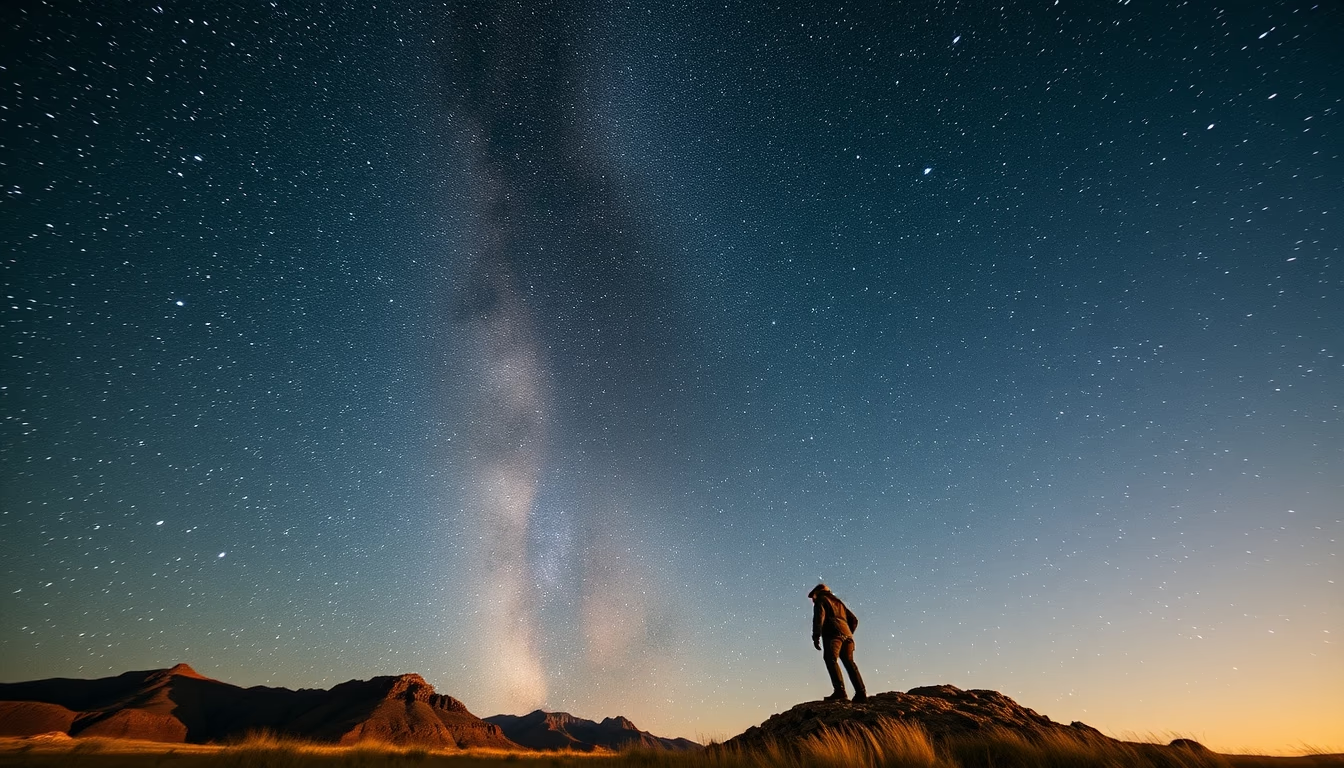
The center of the Milky Way, 26,000 light-years from Earth, is a dense region of stars, dust, and a supermassive black hole.
About this subject
The galactic center of the Milky Way is one of the most fascinating and mysterious regions in the universe. Located in the constellation Sagittarius, approximately 26,000 light-years from Earth, this core hosts Sagittarius A*, a supermassive black hole with a mass of about 4 million Suns. Stellar density is immense: stars cluster in a relatively small volume, orbiting the black hole at extreme speeds. This extreme environment serves as a natural laboratory for testing theories of general relativity and high-energy physics.
Observation of the galactic center is challenging due to vast amounts of interstellar dust blocking visible light. Hence, astronomers use infrared, radio, and X-ray radiation to study it. Projects like the Event Horizon Telescope have captured images of Sagittarius A*'s shadow, confirming the black hole's presence. The Milky Way is a barred spiral galaxy, and its center is the point from which the spiral arms emanate. Recent studies suggest that the nucleus underwent intense periods of star formation and nuclear activity, with gamma-ray bursts that might have affected the evolution of life on Earth.
Besides the black hole, the center hosts young and old star clusters, giant molecular clouds, and supernova remnants. This region is a true mosaic of astrophysical processes. For amateur astronomers, photographing the Milky Way center is a common goal, especially during winter in the southern hemisphere when the galactic core is higher in the night sky. Locations with low light pollution, such as deserts and mountains, offer the best conditions to capture this cosmic beauty.
Frequently Asked Questions
What is Sagittarius A*?
Sagittarius A* is the supermassive black hole at the center of the Milky Way. It has about 4 million times the mass of the Sun and is responsible for intense radiation from the central region.
Why is the center of the Milky Way hard to observe?
Interstellar dust blocks visible light, making it necessary to use infrared, radio, or X-ray telescopes to study the galactic center.
What is the best time to photograph the center of the Milky Way?
In the southern hemisphere, the galactic core is most visible during winter (June to August) when it is high in the night sky. Dark locations with low light pollution are ideal.
Direct URL
https://pub-c7d6a6ea828543ac903a74a341ccb2e1.r2.dev/imagens/milky-way-center-galactic-travel-photography-p0.avifHow to credit
Include a visible link back to UtilizAí. Copy one of the snippets below:
<a href="https://xn--utiliza-eza.com/en/midia/imagens/milky-way-center-galactic-travel-photography-p0">Milky way center galactic</a> by <a href="https://xn--utiliza-eza.com">UtilizAí</a>, licensed under <a href="https://creativecommons.org/licenses/by/4.0/">CC BY 4.0</a>.
[Milky way center galactic](https://xn--utiliza-eza.com/en/midia/imagens/milky-way-center-galactic-travel-photography-p0) by [UtilizAí](https://xn--utiliza-eza.com), CC BY 4.0
License: CC-BY-4.0