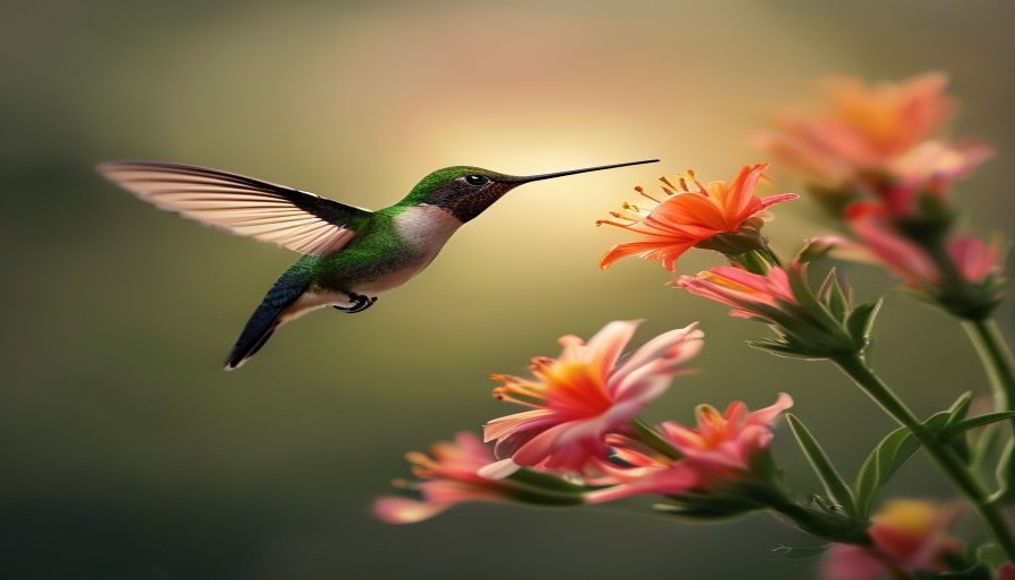
Hummingbird hovering flower
1344×768 · AVIF · CC BY 4.0
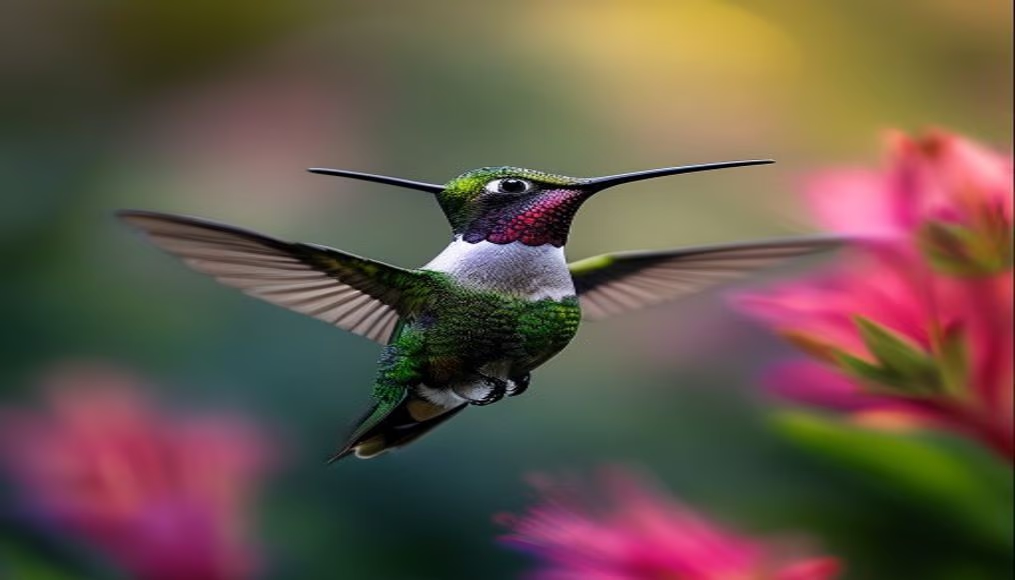
Hummingbird hovering in front of a flower, capturing the precise moment of aerial pollination.
About this subject
Hummingbirds, also known as colibris, belong to the family Trochilidae and are the smallest birds in the world. Endemic to the Americas, these birds possess a unique ability to fly backward and hover in midair with wingbeats reaching 50 to 80 beats per second. This capability allows them to feed on nectar from tubular flowers while hovering, without needing to perch. The hummingbird's forked tongue can extend rapidly to lap up nectar, and they visit hundreds of flowers daily to fuel their high metabolism, which requires consuming up to twice their body weight each day.
The pollination process carried out by hummingbirds is crucial for many plant species, especially those with red or orange flowers that attract these birds. Unlike bees, which focus on pollen, hummingbirds transfer pollen grains along their beak and head while seeking nectar. This contributes to plant genetic variability and the maintenance of healthy ecosystems. The term “wave-pollinations” in the image context may refer to the undulating motion of the wings and body during hovering flight, reminiscent of waves.
From an architectural photography perspective, the image highlights the intricate structure of the wings and the geometry of the hummingbird's motion. The symmetry and repetitive patterns of wingbeats contrast with the organic form of the flower, creating a visual composition that echoes design principles. Hummingbirds are often photographed in botanical gardens or nature reserves, where natural light enhances their iridescent colors, caused by light diffraction on feather microstructures.
Interestingly, the ruby-throated hummingbird (Archilochus colubris) is one of the most common species in North America, while in Brazil the azure-shouldered hummingbird (Amazilia lactea) is frequently seen. These birds have a lifespan of 3 to 5 years in the wild, but some can live over a decade. Their nests are small, made of spiderwebs and moss, usually holding two eggs the size of peas.
Frequently Asked Questions
Why can hummingbirds hover in midair?
Hummingbirds have articulated wings that allow rotational motion, generating lift on both the downstroke and upstroke. Combined with highly developed pectoral muscles, this enables stationary flight.
What is the importance of hummingbirds in pollination?
They are essential pollinators for many tubular-flowered plants, especially in the Americas. While feeding on nectar, they transport pollen grains between flowers, promoting cross-pollination and genetic diversity.
What does 'wave-pollinations' mean in the image context?
The term likely refers to the undulating motion of the hummingbird's wings and body during hovering flight, resembling waves. It may also allude to wave-like pollination patterns.
Direct URL
https://pub-c7d6a6ea828543ac903a74a341ccb2e1.r2.dev/imagens/hummingbird-hovering-flower-architectural-photography-p1.avifHow to credit
Include a visible link back to UtilizAí. Copy one of the snippets below:
<a href="https://xn--utiliza-eza.com/en/midia/imagens/hummingbird-hovering-flower-architectural-photography-p1">Hummingbird hovering flower</a> by <a href="https://xn--utiliza-eza.com">UtilizAí</a>, licensed under <a href="https://creativecommons.org/licenses/by/4.0/">CC BY 4.0</a>.
[Hummingbird hovering flower](https://xn--utiliza-eza.com/en/midia/imagens/hummingbird-hovering-flower-architectural-photography-p1) by [UtilizAí](https://xn--utiliza-eza.com), CC BY 4.0
License: CC-BY-4.0