Horsehead nebula dark
1344×768 · AVIF · CC BY 4.0
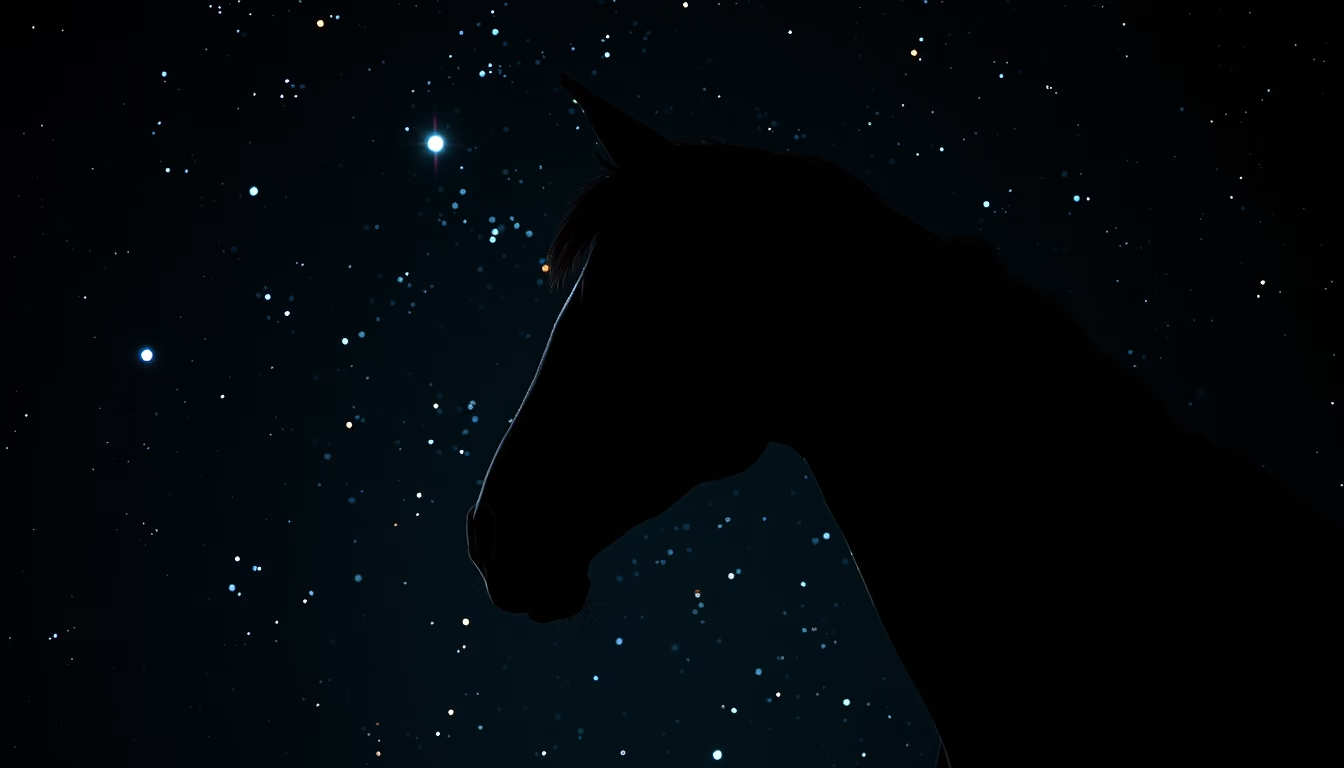
The Horsehead Nebula is a dark cloud of dust and gas in the constellation Orion, one of the most photographed and studied astronomical objects.
About this subject
The Horsehead Nebula, officially known as Barnard 33, is a dark nebula located in the constellation Orion, approximately 1,500 light-years from Earth. It is part of the Orion Molecular Cloud Complex, a vast star-forming region that also includes the Orion Nebula (M42) and Barnard's Loop. The iconic horsehead shape stands out against the reddish background of the emission nebula IC 434, which is illuminated by the star Sigma Orionis. The darkness of the Horsehead results from a dense cloud of interstellar dust that blocks the light from stars and gas behind it.
Discovered in 1888 by Scottish astronomer Williamina Fleming on a photographic plate at the Harvard College Observatory, the nebula is a classic example of a dark nebula. Unlike emission or reflection nebulae, dark nebulae do not emit visible light of their own; they are visible only as silhouettes against background light sources. The reddish background color comes from ionized hydrogen (Hα) emission, excited by ultraviolet radiation from young, hot stars in the region.
The Horsehead Nebula is a natural laboratory for studying the interstellar medium and star formation. Infrared and radio observations reveal internal structures and dense cores where new stars may be forming. Despite its dramatic appearance, the nebula is relatively faint and small in the sky: it spans about 3.5 light-years in diameter and, to be seen visually, requires medium-sized telescopes and very dark skies. Long-exposure photographs, such as those using authentic film grain, capture its intricate details and contrasting beauty.
Interestingly, the Horsehead Nebula is gradually dissipating. It is estimated that radiation from Sigma Orionis is eroding the dust cloud, and in about 5 million years the characteristic shape may disappear. This process of photoevaporation is common in star-forming regions. The nebula's popularity grew immensely with images from the Hubble Space Telescope, which show its fine texture and surrounding gas filaments. For amateur astrophotographers, capturing the Horsehead is a technical challenge that rewards with one of the most iconic views of the night sky.
Frequently Asked Questions
What is the Horsehead Nebula?
It is a dark nebula in the constellation Orion, composed of dust and gas that blocks background light, creating a silhouetted horsehead shape. It lies 1,500 light-years from Earth.
Why is the Horsehead Nebula red?
The red color comes from the ionized hydrogen gas (IC 434) behind it, which emits light at the Hα frequency. The dark dust of the nebula has no color of its own, only contrasts against the bright background.
Can you see the Horsehead Nebula with the naked eye?
No. It is very faint and small. To observe it visually, you need a telescope with at least 200 mm aperture and very dark skies. Long-exposure photography reveals more details.
Direct URL
https://pub-c7d6a6ea828543ac903a74a341ccb2e1.r2.dev/imagens/horsehead-nebula-dark-film-grain-authentic-p2.avifHow to credit
Include a visible link back to UtilizAí. Copy one of the snippets below:
<a href="https://xn--utiliza-eza.com/en/midia/imagens/horsehead-nebula-dark-film-grain-authentic-p2">Horsehead nebula dark</a> by <a href="https://xn--utiliza-eza.com">UtilizAí</a>, licensed under <a href="https://creativecommons.org/licenses/by/4.0/">CC BY 4.0</a>.
[Horsehead nebula dark](https://xn--utiliza-eza.com/en/midia/imagens/horsehead-nebula-dark-film-grain-authentic-p2) by [UtilizAí](https://xn--utiliza-eza.com), CC BY 4.0
License: CC-BY-4.0