Hash function visualization cryptographic equations on glass screen
1344×768 · AVIF · CC BY 4.0
Hash functions are mathematical algorithms that transform data into fixed-length strings, essential for digital security and blockchain.
About this subject
Hash functions are cryptographic algorithms that map data of arbitrary size to a fixed-size output, typically a sequence of bytes. This output, called a hash or digest, acts as a digital fingerprint of the original data. A fundamental property is irreversibility: given a hash, it is computationally infeasible to recover the original input. Additionally, small changes in the input produce completely different hashes, known as the avalanche effect.
In the context of blockchain, hash functions are the backbone of data integrity. Each block contains the hash of the previous block, forming an immutable chain. Bitcoin, for example, uses SHA-256 (Secure Hash Algorithm 256-bit) for mining and transaction verification. Any attempt to alter a past block would require recalculating all subsequent hashes, which is prohibitive in terms of computational power.
Beyond blockchain, hash functions are used in digital signatures, password authentication (storing only the hash), and file integrity verification. Common algorithms include MD5 (now considered insecure), SHA-1 (also obsolete for security), and the SHA-2 family (SHA-224, SHA-256, SHA-384, SHA-512). SHA-3, the latest, was standardized by NIST in 2015 and offers resistance to collision attacks.
A curiosity: the search for a hash with specific characteristics (e.g., starting with a certain number of zeros) is the basis of cryptocurrency mining. Miners compete to find a nonce (number used once) that, combined with block data, produces a hash below a difficulty target. This process consumes enormous global electrical energy, fueling debates about sustainability.
Frequently Asked Questions
What is a hash function and what is it used for?
A hash function is a mathematical algorithm that transforms any input into a fixed-length string. It is used for data integrity verification, secure password storage, and ensuring blockchain immutability.
Why are hash functions important for blockchain?
In blockchain, each block contains the hash of the previous block, creating an immutable chain. Altering a block would require recalculating all subsequent hashes, making fraud computationally infeasible.
What is the difference between SHA-256 and SHA-3?
SHA-256 belongs to the SHA-2 family, widely used in Bitcoin. SHA-3 is a newer standard with a different structure (sponge construction), offering resistance to new types of attacks.
Direct URL
https://pub-c7d6a6ea828543ac903a74a341ccb2e1.r2.dev/imagens/hash-function-visualization-cryptographic-equations-on-glass-screen-closeup-macro-shot-bright-midday-sun.avifHow to credit
Include a visible link back to UtilizAí. Copy one of the snippets below:
<a href="https://xn--utiliza-eza.com/en/midia/imagens/hash-function-visualization-cryptographic-equations-on-glass-screen-closeup-macro-shot-bright-midday-sun">Hash function visualization cryptographic equations on glass screen</a> by <a href="https://xn--utiliza-eza.com">UtilizAí</a>, licensed under <a href="https://creativecommons.org/licenses/by/4.0/">CC BY 4.0</a>.
[Hash function visualization cryptographic equations on glass screen](https://xn--utiliza-eza.com/en/midia/imagens/hash-function-visualization-cryptographic-equations-on-glass-screen-closeup-macro-shot-bright-midday-sun) by [UtilizAí](https://xn--utiliza-eza.com), CC BY 4.0
License: CC-BY-4.0
Tags
Related images
 Smart contract code on monitor with solidity syntax highlighted
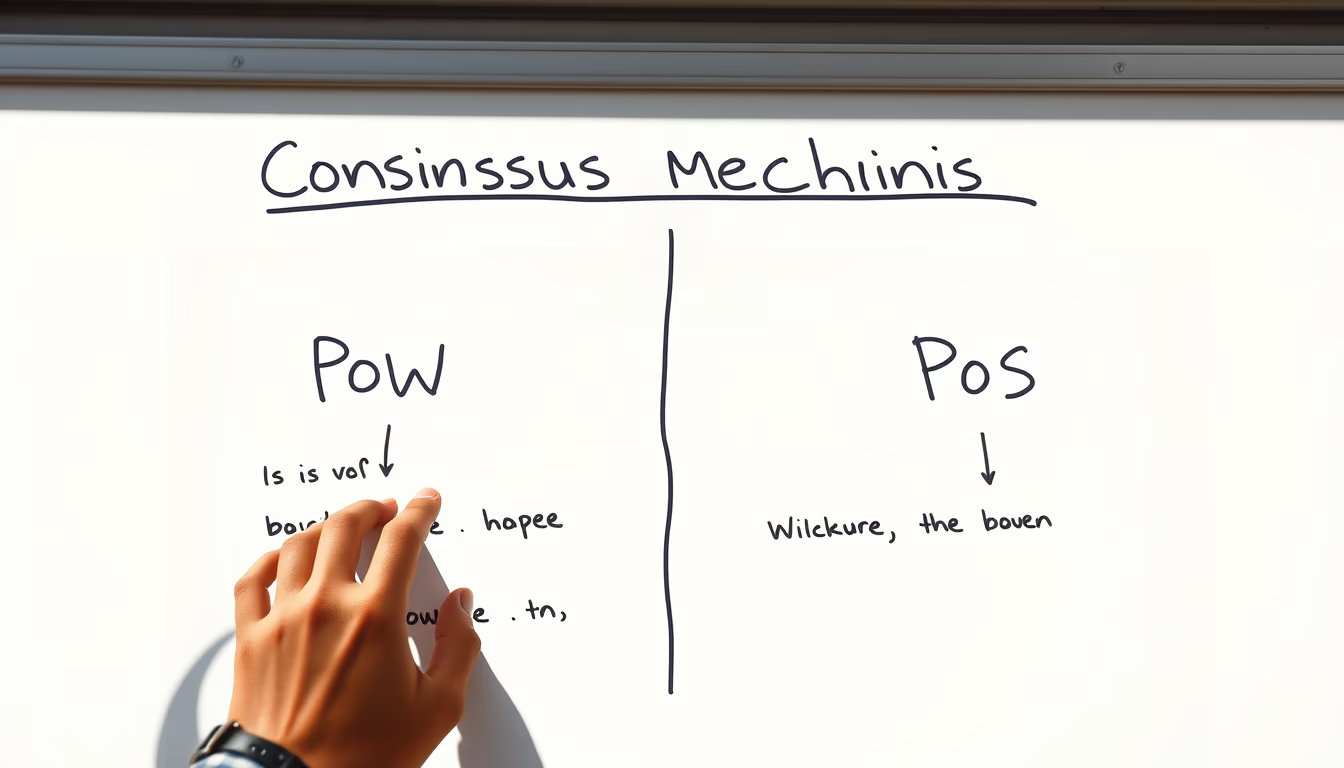 Consensus mechanism diagram on whiteboard showing PoW vs PoS
 Distributed ledger multiple servers in data center
 Hash function visualization cryptographic equations on glass screen
 Hash function visualization cryptographic equations on glass screen
 Hash function visualization cryptographic equations on glass screen