Exoplanet earth-like
1344×768 · AVIF · CC BY 4.0
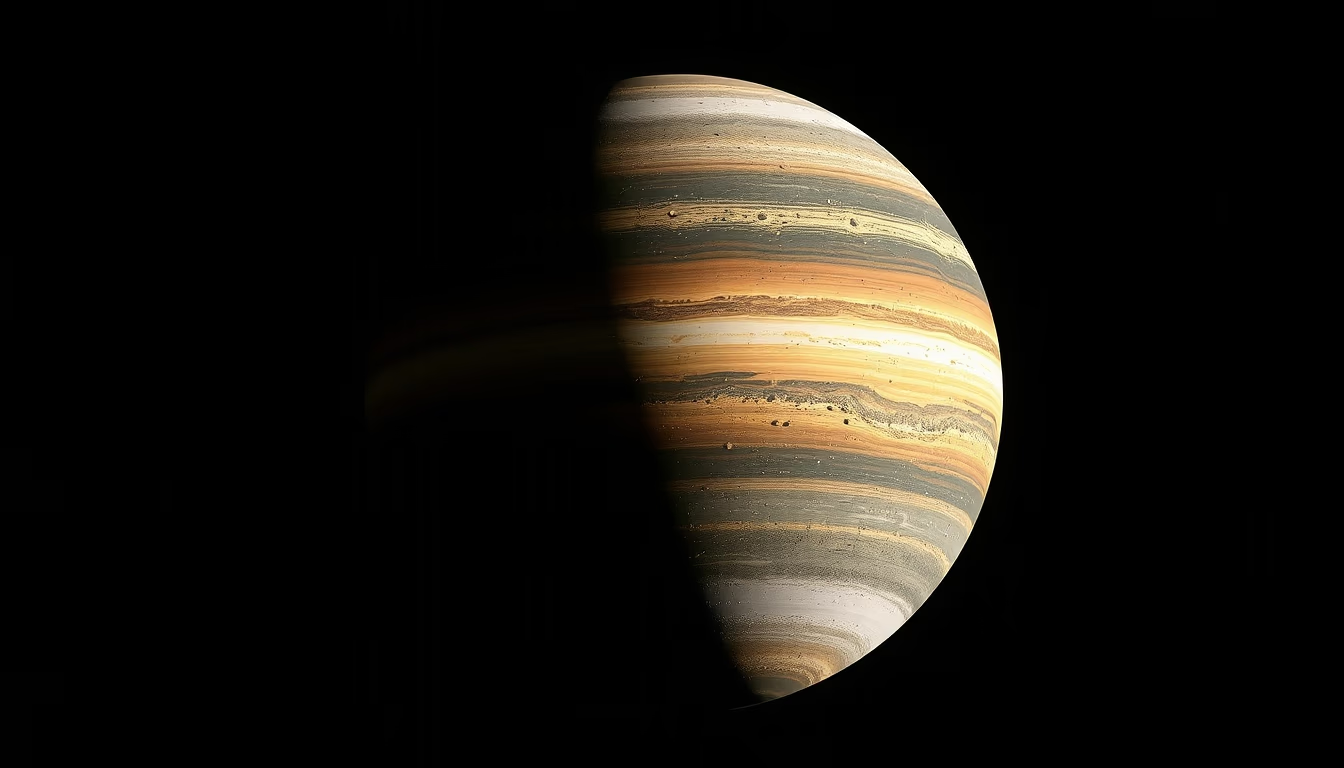
Earth-like exoplanets are rocky worlds orbiting other stars that may harbor conditions similar to Earth sparking interest in astrobiology.
About this subject
The search for Earth-like exoplanets is a major goal of modern astronomy. Since the first exoplanet discovery in 1992, the number of candidates has grown to thousands, highlighted by missions like the Kepler Space Telescope (2009, 2018) which confirmed over 2,600 exoplanets. Among them, many are Earth-sized and lie within the habitable zone, where temperatures allow liquid water on the surface.
Notable examples include Proxima Centauri b, discovered in 2016 orbiting the closest star to the Sun at only 4.2 light-years away. The TRAPPIST-1 system, announced in 2017, features seven rocky planets with three in the habitable zone. However detailed characterization is challenging: most are detected by indirect methods such as transit or radial velocity, and their atmospheres remain poorly understood.
The search for extraterrestrial life relies on spectral analysis of starlight passing through these planets' atmospheres. Future instruments like the James Webb Space Telescope and the Extremely Large Telescope (ELT) could detect biosignatures such as oxygen, methane and water vapor. Furthermore the diversity of Earth-like exoplanets reveals a striking range of conditions from water worlds to scorching deserts, expanding our understanding of planetary formation and the possibility of life in the universe.
Frequently Asked Questions
What is an Earth-like exoplanet?
It is a rocky planet with size and mass similar to Earth that orbits a star within the habitable zone, where liquid water can exist on the surface. Examples include Proxima Centauri b and the planets of the TRAPPIST-1 system.
How many Earth-like exoplanets have been discovered?
Over 150 confirmed exoplanets are considered Earth-sized and potentially habitable, though their atmospheric compositions remain uncertain.
How do astronomers detect Earth-like exoplanets?
Common methods are the transit method, where the planet passes in front of its star dimming its light, and the radial velocity method, which measures the star's wobble due to the planet's gravitational pull.
Direct URL
https://pub-c7d6a6ea828543ac903a74a341ccb2e1.r2.dev/imagens/exoplanet-earth-like-minimalist-composition-p5.avifHow to credit
Include a visible link back to UtilizAí. Copy one of the snippets below:
<a href="https://xn--utiliza-eza.com/en/midia/imagens/exoplanet-earth-like-minimalist-composition-p5">Exoplanet earth-like</a> by <a href="https://xn--utiliza-eza.com">UtilizAí</a>, licensed under <a href="https://creativecommons.org/licenses/by/4.0/">CC BY 4.0</a>.
[Exoplanet earth-like](https://xn--utiliza-eza.com/en/midia/imagens/exoplanet-earth-like-minimalist-composition-p5) by [UtilizAí](https://xn--utiliza-eza.com), CC BY 4.0
License: CC-BY-4.0