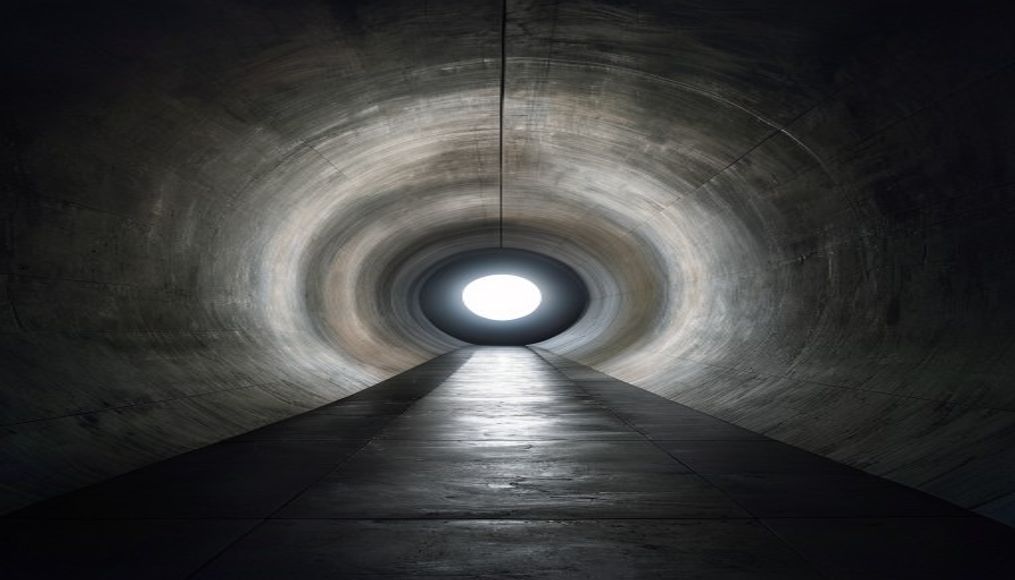
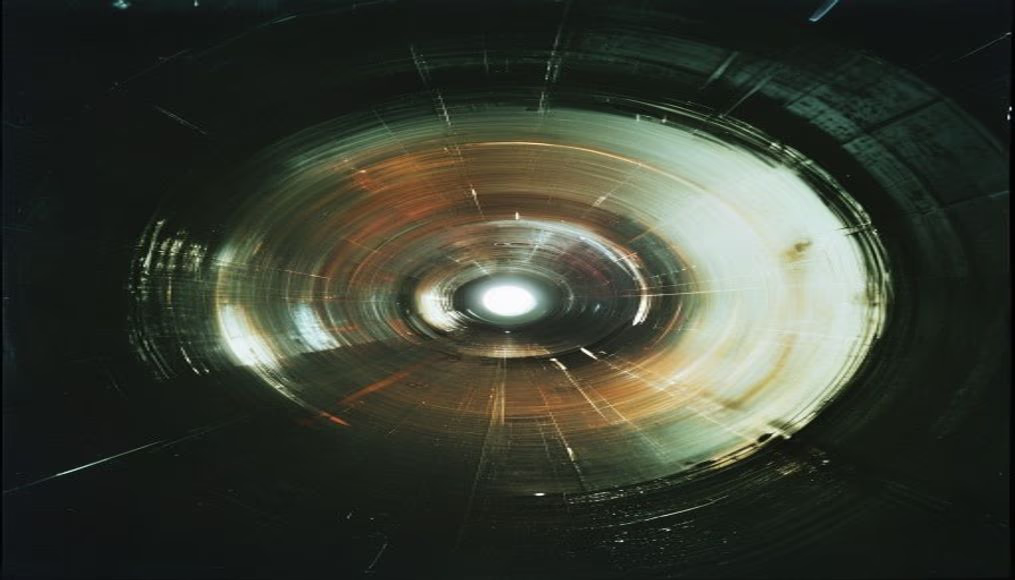
Dark matter visualization
1344×768 · AVIF · CC BY 4.0

Dark matter accounts for about 85% of the Universe's mass yet emits no light. Visualizations like this help scientists map its distribution on cosmic scales.
About this subject
Dark matter is a hypothetical form of matter that does not interact with electromagnetic radiation, making it invisible to conventional telescopes. Its existence was inferred from gravitational effects, such as galaxy rotation curves and the large-scale structure of the Universe. It is thought to account for approximately 85% of the total mass in the cosmos, acting as a gravitational scaffold that attracts visible matter to form galaxies and clusters.
To visualize dark matter, astrophysicists use computer simulations based on cosmological models, such as the Lambda-CDM (Cold Dark Matter) model. These simulations reproduce the evolution of the Universe from the Big Bang to the present day, showing how dark matter clumps under gravity to form a cosmic web of filaments and halos. A typical dark matter visualization displays dense regions (halos) connected by thin filaments, with large voids in between.
The importance of these visualizations goes beyond aesthetics: they allow testing of cosmological theories and comparison with actual observations of galaxy distributions. Projects like the Sloan Digital Sky Survey (SDSS) and the James Webb Space Telescope provide data that are compared with simulations. Discrepancies between predicted and observed patterns may indicate the need for model adjustments or even new physics beyond the Standard Model.
An interesting fact is that dark matter has not been directly detected in laboratories despite decades of experiments. Visualization remains a key tool to understand its nature, especially when combined with gravitational lensing data, which reveals the presence of dark matter along the line of sight by distorting the light from distant galaxies.
Frequently Asked Questions
What is dark matter?
Dark matter is an invisible form of matter that does not emit, absorb, or reflect light. Its presence is inferred from its gravitational effects on visible matter, such as galaxy rotation speeds and the formation of cosmic structures.
How do scientists create dark matter visualizations?
They use computer simulations that model the evolution of the Universe from the Big Bang, following the laws of gravity. These simulations generate three-dimensional maps of dark matter distribution, which are then rendered as images.
Why is visualizing dark matter important?
Visualizations help compare theoretical predictions with actual observations of galaxies and gravitational lensing. This allows testing of cosmological models and searching for evidence of physics beyond the standard model.
Direct URL
https://pub-c7d6a6ea828543ac903a74a341ccb2e1.r2.dev/imagens/dark-matter-visualization-travel-photography-p7.avifHow to credit
Include a visible link back to UtilizAí. Copy one of the snippets below:
<a href="https://xn--utiliza-eza.com/en/midia/imagens/dark-matter-visualization-travel-photography-p7">Dark matter visualization</a> by <a href="https://xn--utiliza-eza.com">UtilizAí</a>, licensed under <a href="https://creativecommons.org/licenses/by/4.0/">CC BY 4.0</a>.
[Dark matter visualization](https://xn--utiliza-eza.com/en/midia/imagens/dark-matter-visualization-travel-photography-p7) by [UtilizAí](https://xn--utiliza-eza.com), CC BY 4.0
License: CC-BY-4.0