Black hole event horizon
1344×768 · AVIF · CC BY 4.0
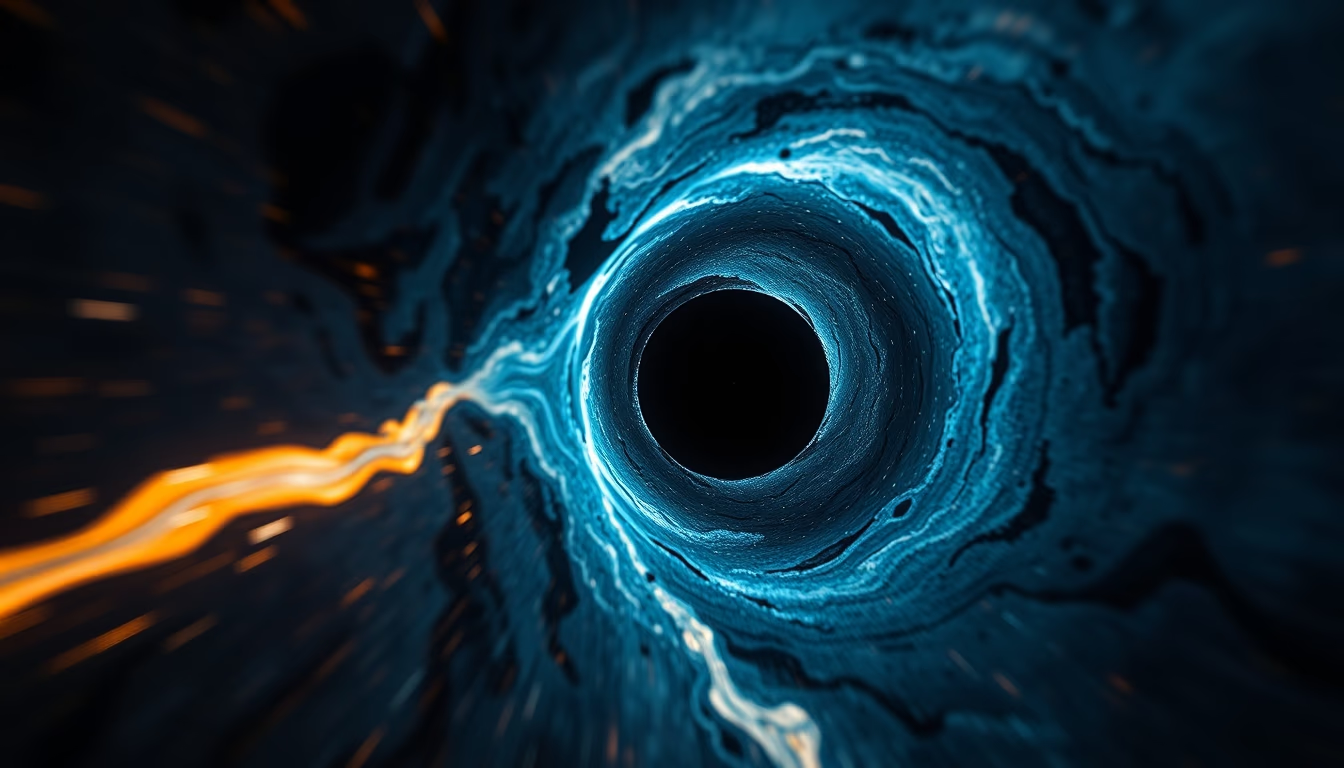
The event horizon of a black hole is the point of no return where gravity is so intense that even light cannot escape.
About this subject
The event horizon is the theoretical boundary that defines a black hole. Beyond this limit, the escape velocity exceeds the speed of light, making it impossible for any information or matter to return to the outside. Physicists like Karl Schwarzschild first described this region in 1916 as a singularity surrounded by a spherical surface. The radius of the event horizon, called the Schwarzschild radius, is proportional to the black hole's mass: for a solar-mass object, it would be about 3 kilometers.
The first direct image of an event horizon was obtained by the Event Horizon Telescope (EHT) in 2019, depicting the supermassive black hole at the center of galaxy M87, with a mass of 6.5 billion suns. The image showed a bright ring of plasma orbiting the event horizon and a dark shadow in the center. This result confirmed predictions of Einstein's General Relativity and opened new avenues for studying extreme gravity.
Inside the event horizon, the laws of physics as we know them break down. Time and space swap roles: time inevitably flows toward the central singularity. Any object crossing the horizon is stretched in a process called spaghettification, due to extreme tidal forces. Interestingly, for a distant observer, an object appears to freeze and redden before disappearing, a relativistic effect known as gravitational redshift.
Black holes can be stellar-mass (forming from collapsed massive stars) or supermassive (at galaxy centers). The event horizon is not a solid physical surface but a mathematical boundary. Research continues into black hole thermodynamics, Hawking radiation, and paradoxes like the information loss paradox, challenging our understanding of the universe.
Frequently Asked Questions
What happens if someone crosses the event horizon?
Upon crossing the event horizon, the person would be stretched by tidal forces (spaghettification) and inevitably reach the central singularity, where matter is compressed to infinite density. From an external viewpoint, they would appear to freeze and disappear due to gravitational redshift.
Can we directly see an event horizon?
Indirectly, yes. The Event Horizon Telescope (EHT) imaged the shadow of the black hole in M87 in 2019, revealing the ring of light around the event horizon. The dark silhouette is the region where light cannot escape.
Is the event horizon a fixed size?
The size of the event horizon depends on the black hole's mass. The larger the mass, the larger the Schwarzschild radius. For example, a solar-mass black hole has a radius of 3 km, while the supermassive one in M87 has a radius of about 20 billion km.
Direct URL
https://pub-c7d6a6ea828543ac903a74a341ccb2e1.r2.dev/imagens/black-hole-event-horizon-fish-eye-wide-angle-p3.avifHow to credit
Include a visible link back to UtilizAí. Copy one of the snippets below:
<a href="https://xn--utiliza-eza.com/en/midia/imagens/black-hole-event-horizon-fish-eye-wide-angle-p3">Black hole event horizon</a> by <a href="https://xn--utiliza-eza.com">UtilizAí</a>, licensed under <a href="https://creativecommons.org/licenses/by/4.0/">CC BY 4.0</a>.
[Black hole event horizon](https://xn--utiliza-eza.com/en/midia/imagens/black-hole-event-horizon-fish-eye-wide-angle-p3) by [UtilizAí](https://xn--utiliza-eza.com), CC BY 4.0
License: CC-BY-4.0