Black hole event horizon
1344×768 · AVIF · CC BY 4.0
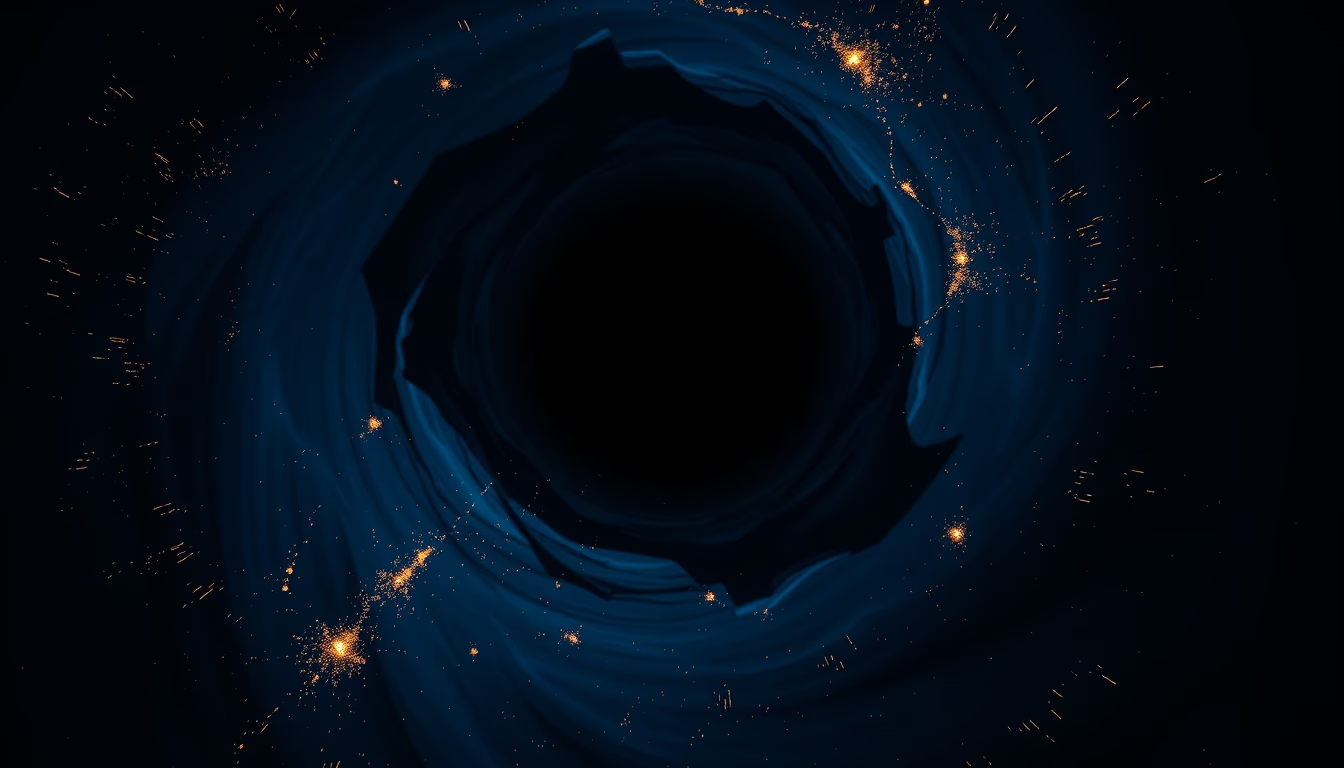
The event horizon of a black hole is the point of no return where gravity is so intense that not even light can escape.
About this subject
The event horizon is the hypothetical boundary around a black hole from which nothing, including light, can return to the outside. It marks the limit where gravitational force becomes infinite in general relativity. Any object or radiation crossing this surface is irrevocably pulled into the central singularity.
The existence of event horizons was predicted by Karl Schwarzschild in 1916, shortly after Einstein published the theory of general relativity. The Schwarzschild radius defines the size of the event horizon for a non-rotating black hole: the larger the mass, the larger the radius. For example, the supermassive black hole at the center of the Milky Way, Sagittarius A*, with about 4 million solar masses, has an event horizon with a radius of approximately 12 million kilometers.
Directly observing an event horizon is impossible because it emits no radiation. However, in 2019, the Event Horizon Telescope (EHT) captured the first image of a black hole shadow in M87, showing the outline of the event horizon illuminated by surrounding matter. This achievement confirmed theoretical predictions and opened new windows for studying these extreme objects.
Interestingly, the event horizon is not a solid physical surface but a mathematical boundary in spacetime. For a distant observer, an object falling toward the horizon appears to slow down and never cross it due to gravitational time dilation. For the object itself, the crossing occurs in finite time, but communication with the outside ceases instantly.
Frequently Asked Questions
What happens if someone crosses the event horizon?
Once inside the event horizon, gravity is so intense that any path leads inevitably to the central singularity. Communication with the outside is impossible, and the person would be stretched in a process called spaghettification due to tidal forces.
Can we see an event horizon?
Not directly, as it emits no light. However, we can observe its shadow against surrounding matter, as done by the Event Horizon Telescope in 2019, which revealed the outline of the event horizon of the M87 black hole.
What is the difference between event horizon and ergosphere?
In rotating (Kerr) black holes, the ergosphere is a region outside the event horizon where objects are forced to co-rotate with the black hole but can still escape. The event horizon is the point of no return, where escape is impossible.
Direct URL
https://pub-c7d6a6ea828543ac903a74a341ccb2e1.r2.dev/imagens/black-hole-event-horizon-aerial-drone-shot-p8.avifHow to credit
Include a visible link back to UtilizAí. Copy one of the snippets below:
<a href="https://xn--utiliza-eza.com/en/midia/imagens/black-hole-event-horizon-aerial-drone-shot-p8">Black hole event horizon</a> by <a href="https://xn--utiliza-eza.com">UtilizAí</a>, licensed under <a href="https://creativecommons.org/licenses/by/4.0/">CC BY 4.0</a>.
[Black hole event horizon](https://xn--utiliza-eza.com/en/midia/imagens/black-hole-event-horizon-aerial-drone-shot-p8) by [UtilizAí](https://xn--utiliza-eza.com), CC BY 4.0
License: CC-BY-4.0





