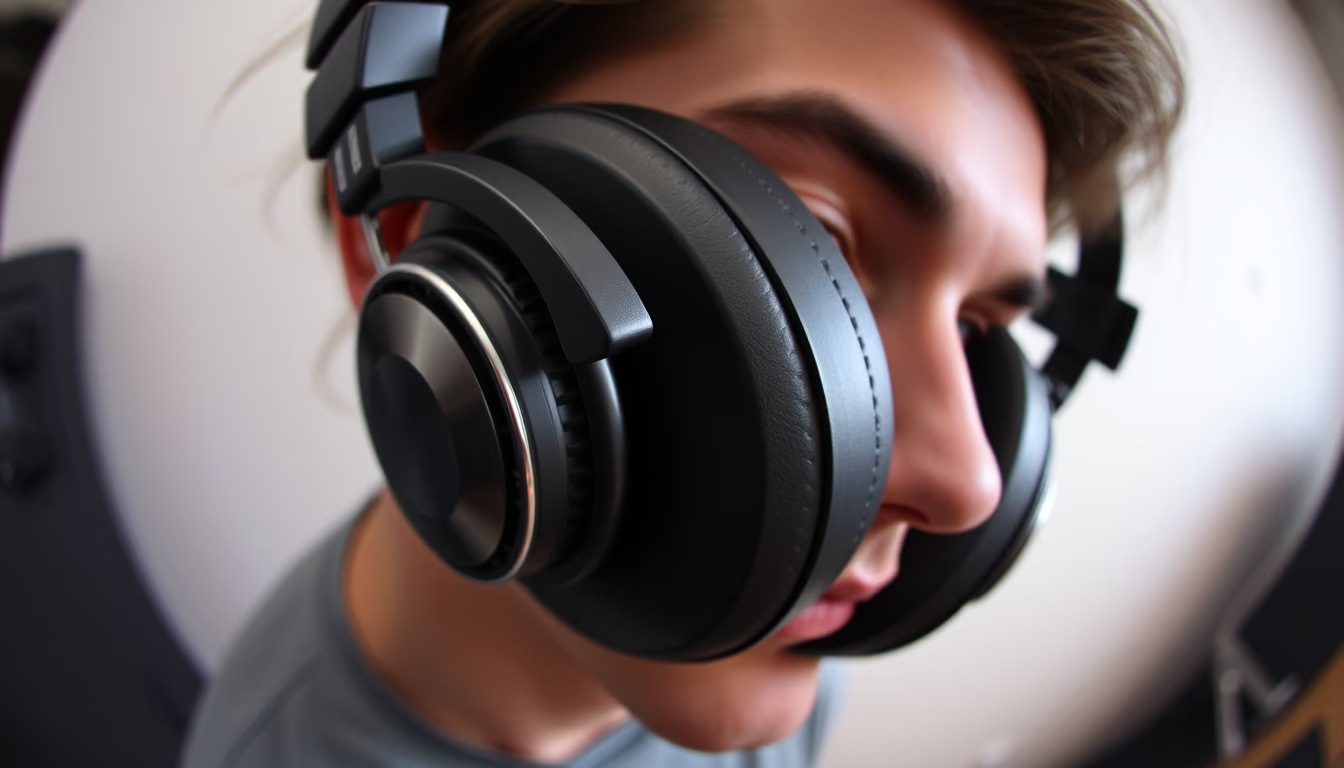
Audiophile headphones planar
1344×768 · AVIF · CC BY 4.0

Planar magnetic headphones deliver high-fidelity audio using thin diaphragms between magnets for precise response and low distortion.
About this subject
Planar magnetic headphones, also known as isodynamic or orthodynamic, represent a transducer technology distinct from traditional dynamic drivers. Instead of a voice coil attached to a cone, a planar driver uses an ultra-thin diaphragm (typically Mylar or PET) with an etched conductive trace. That diaphragm is suspended between two arrays of neodymium magnets. When electrical current flows through the trace, the diaphragm moves uniformly, producing sound with extremely low distortion and fast transient response.
The history of planar headphones dates to the 1970s, when Japan's Yamaha introduced the HP-1 and the Orthodynamic Series. However, the modern design gained traction with brands like HiFiMAN (HE-5, HE-6) and Audeze (LCD-2). Current models can weigh from 300 g to over 700 g due to powerful magnets, yet they offer a unique sonic experience: wide soundstage, exceptional detail, and deep, controlled bass. Impedance is typically low (20, 50 ohms) but sensitivity is low, requiring dedicated amplifiers to perform properly.
In the United States and Europe, planar headphones are a niche but growing segment, with models like the HiFiMAN Sundara (entry-level) and the Audeze LCD-X (professional). Maintenance requires care with the delicate diaphragm, which can be damaged by excessive pressure or humidity. Planar technology is often compared to electrostatic speakers but has the advantage of not needing special high-voltage amplifiers.
Trivia: HiFiMAN was founded by Dr. Fang Bian, a former nuclear physicist who brought innovations like magnet grid arrays and nanoscale diaphragms. Planar headphones are also used in mastering studios where accuracy is paramount.
Frequently Asked Questions
What does planar magnetic mean in headphones?
It means the sound is produced by a thin diaphragm with a conductive trace suspended between magnets. Electrical current makes the diaphragm vibrate uniformly, resulting in low distortion and fast transient response.
Do planar headphones require an amplifier?
Yes, most planar headphones have low sensitivity (80, 95 dB/mW) and low impedance, but need sufficient current. Dedicated headphone amplifiers or powerful DAPs are recommended to get the best performance.
What is the difference between planar and dynamic headphones?
Dynamic headphones use a cone with a voice coil inside a magnetic field. Planars use a flat diaphragm between magnets. Planars have lower distortion, faster transient response, and wider soundstage, but are heavier and more expensive.
Direct URL
https://pub-c7d6a6ea828543ac903a74a341ccb2e1.r2.dev/imagens/audiophile-headphones-planar-fine-art-photography-fresh7.avifHow to credit
Include a visible link back to UtilizAí. Copy one of the snippets below:
<a href="https://xn--utiliza-eza.com/en/midia/imagens/audiophile-headphones-planar-fine-art-photography-fresh7">Audiophile headphones planar</a> by <a href="https://xn--utiliza-eza.com">UtilizAí</a>, licensed under <a href="https://creativecommons.org/licenses/by/4.0/">CC BY 4.0</a>.
[Audiophile headphones planar](https://xn--utiliza-eza.com/en/midia/imagens/audiophile-headphones-planar-fine-art-photography-fresh7) by [UtilizAí](https://xn--utiliza-eza.com), CC BY 4.0
License: CC-BY-4.0