Astronaut spacewalk earth view
1344×768 · AVIF · CC BY 4.0
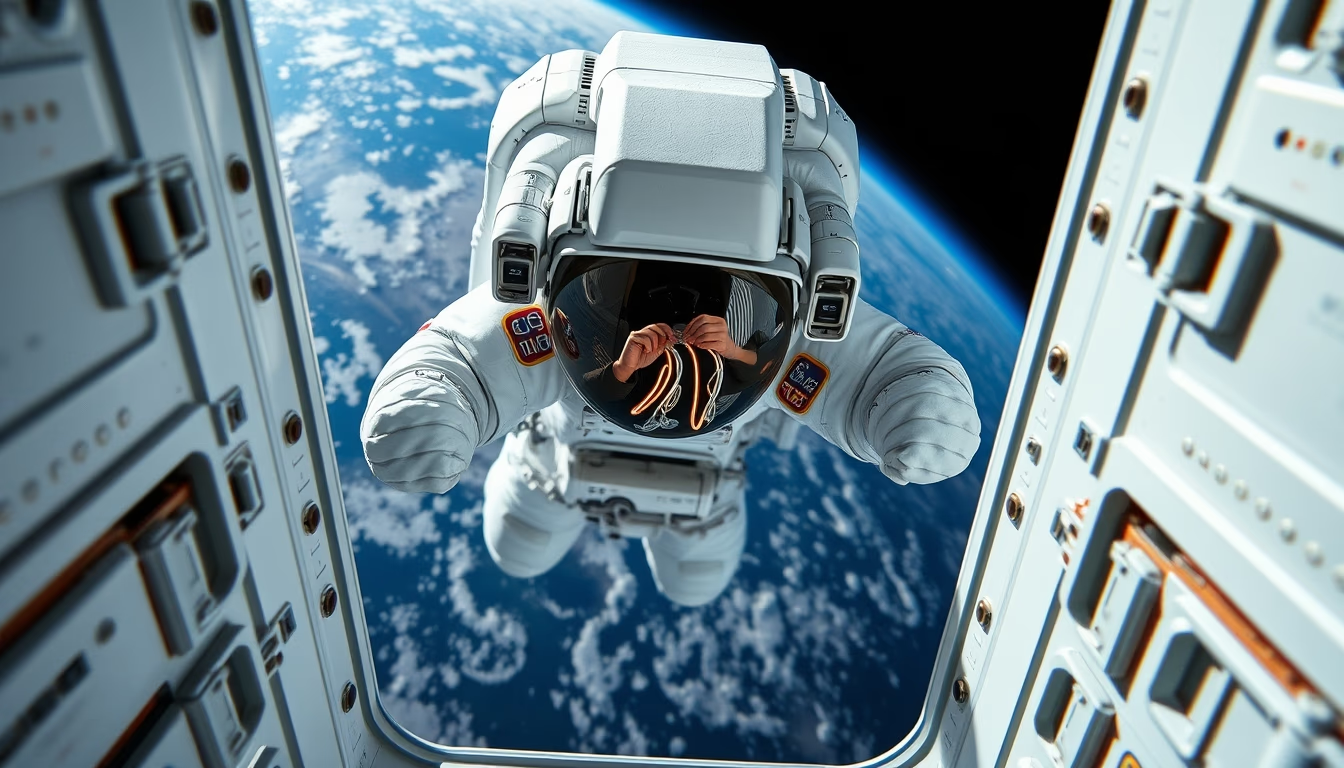
Astronauts on a spacewalk gaze at planet Earth from a unique perspective, capturing the beauty and fragility of our world.
About this subject
A spacewalk, or extravehicular activity (EVA), is one of the most challenging and fascinating experiences for an astronaut. Conducted outside the spacecraft or space station, the EVA requires months of training in simulators and neutral buoyancy pools, such as NASA's Neutral Buoyancy Lab. Since Alexei Leonov's first steps in 1965, over 500 spacewalks have been performed, accumulating thousands of hours of work in vacuum. The primary objective is maintenance and repair of equipment, such as the solar panels of the International Space Station (ISS), or the installation of new modules and scientific experiments.
Floating in space with Earth slowly turning below, astronauts describe a psychological phenomenon known as the 'overview effect'. The view of the planet without borders, with its thin blue atmosphere against the infinite blackness, provokes a profound shift in perspective on the unity and fragility of humanity. The famous 'Earthrise' photograph taken during the Apollo 8 mission, or the iconic 'Blue Marble' from Apollo 17, partially capture that feeling, but astronauts claim the personal experience is indescribable.
An EVA can last from 5 to 8 hours, depending on the complexity of the task. Current spacesuits, such as the American EMU or the Russian Orlan, are miniature spaceships, providing oxygen, thermal regulation, and communication. Every movement must be calculated, as the smallest mistake can have serious consequences. Safety is paramount: astronauts are tethered by safety cables and use backup propulsion systems like SAFER (Simplified Aid For EVA Rescue). With the advancement of the Artemis missions to the Moon and future voyages to Mars, spacewalks will continue to evolve, demanding new suits and protocols for extraterrestrial environments.
Frequently Asked Questions
How long does a typical spacewalk last?
A typical EVA lasts between 5 and 8 hours, depending on tasks and the consumption of oxygen and batteries in the suit.
What do astronauts feel when seeing Earth from space?
Many report the 'overview effect', a shift in perspective highlighting the unity and fragility of the planet, with no visible borders.
How many spacewalks have been performed?
As of 2024, more than 500 EVAs have been performed, mostly for maintenance of the International Space Station and earlier missions.
Direct URL
https://pub-c7d6a6ea828543ac903a74a341ccb2e1.r2.dev/imagens/astronaut-spacewalk-earth-view-national-geographic-style-p0.avifHow to credit
Include a visible link back to UtilizAí. Copy one of the snippets below:
<a href="https://xn--utiliza-eza.com/en/midia/imagens/astronaut-spacewalk-earth-view-national-geographic-style-p0">Astronaut spacewalk earth view</a> by <a href="https://xn--utiliza-eza.com">UtilizAí</a>, licensed under <a href="https://creativecommons.org/licenses/by/4.0/">CC BY 4.0</a>.
[Astronaut spacewalk earth view](https://xn--utiliza-eza.com/en/midia/imagens/astronaut-spacewalk-earth-view-national-geographic-style-p0) by [UtilizAí](https://xn--utiliza-eza.com), CC BY 4.0
License: CC-BY-4.0