Asteroid surface rocky
1344×768 · AVIF · CC BY 4.0
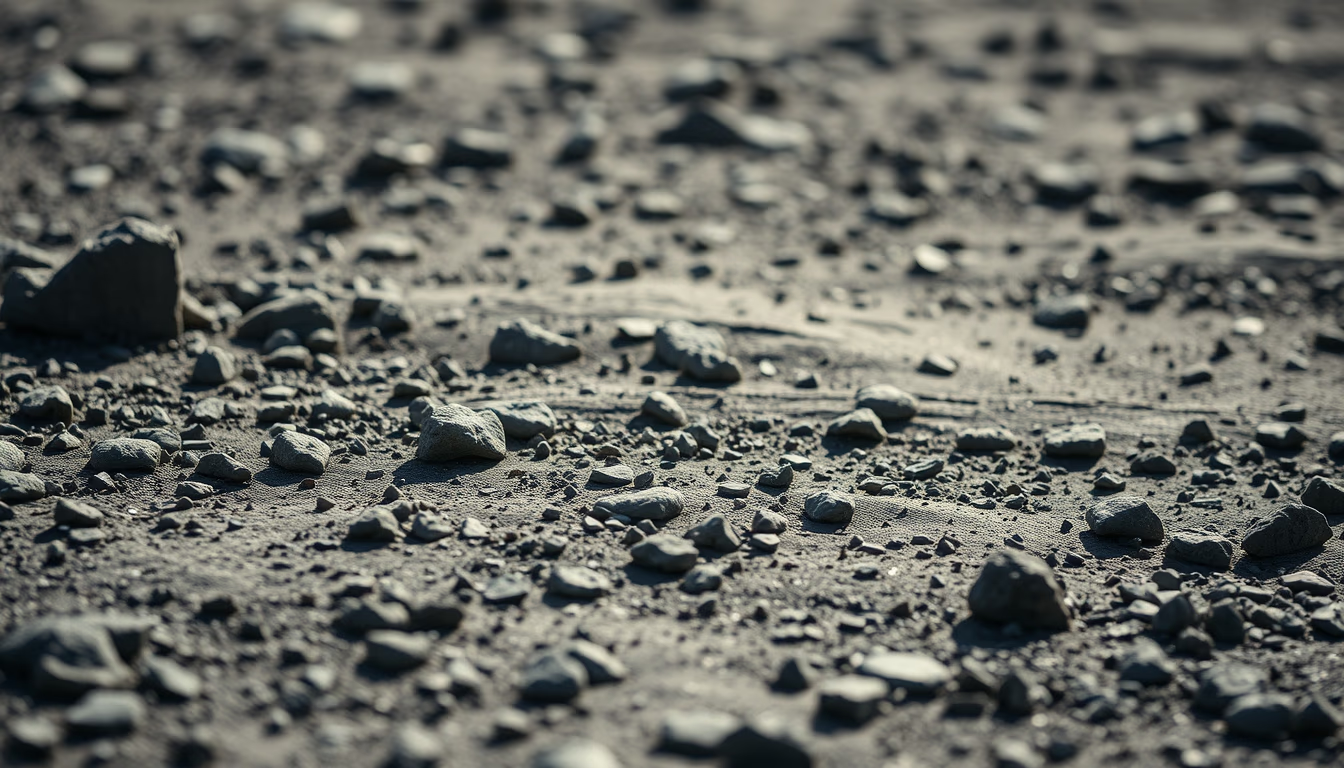
Rocky asteroid surface showing craters, regolith, and ancient impact signs, a key subject for planetary science.
About this subject
Rocky asteroids, also known as S-type (silicaceous), are celestial bodies composed mainly of iron and magnesium silicates. They originate in the main belt between Mars and Jupiter, where collisions and fragmentation have shaped their surfaces. The rough texture seen in high-resolution images results from billions of years of micrometeorite impacts, producing a fine regolith layer and angular fragments.
The topography of a rocky asteroid includes craters of various sizes, grooves, and loose boulders. Examples like Itokawa and Bennu show surfaces covered with irregular blocks whose distribution reveals the history of collisions and material strength. Studying these features helps understand the dynamic evolution of the early solar system.
Exploration of rocky asteroids is vital for planetary science. Missions such as Hayabusa (JAXA) and OSIRIS-REx (NASA) collected regolith samples from Itokawa and Bennu, providing data on composition and age. Additionally, rocky asteroids are potential targets for space mining due to the presence of metals and bound water.
Planetary defense also relies on knowledge of these surfaces. Characterizing regolith porosity and cohesion is crucial for planning impact deflection missions. Every crater and depression tells a story of cosmic collisions that ultimately help predict future risks to Earth.
Frequently Asked Questions
What composes the surface of a rocky asteroid?
The surface is covered by regolith, a layer of dust and loose rock fragments, along with impact craters and large boulders. The mineral composition is dominated by silicates such as olivine and pyroxene.
Why study rocky asteroids?
They preserve records of the solar system's formation 4.6 billion years ago. Additionally, they contain resources like metals and water, making them targets for space mining and planetary defense.
Which missions have visited rocky asteroids?
The Hayabusa (JAXA) and OSIRIS-REx (NASA) missions collected samples from asteroids Itokawa and Bennu. The Psyche mission (NASA) will study the metallic asteroid 16 Psyche.
Direct URL
https://pub-c7d6a6ea828543ac903a74a341ccb2e1.r2.dev/imagens/asteroid-surface-rocky-documentary-photography-p4.avifHow to credit
Include a visible link back to UtilizAí. Copy one of the snippets below:
<a href="https://xn--utiliza-eza.com/en/midia/imagens/asteroid-surface-rocky-documentary-photography-p4">Asteroid surface rocky</a> by <a href="https://xn--utiliza-eza.com">UtilizAí</a>, licensed under <a href="https://creativecommons.org/licenses/by/4.0/">CC BY 4.0</a>.
[Asteroid surface rocky](https://xn--utiliza-eza.com/en/midia/imagens/asteroid-surface-rocky-documentary-photography-p4) by [UtilizAí](https://xn--utiliza-eza.com), CC BY 4.0
License: CC-BY-4.0