Andromeda galaxy spiral
1344×768 · AVIF · CC BY 4.0
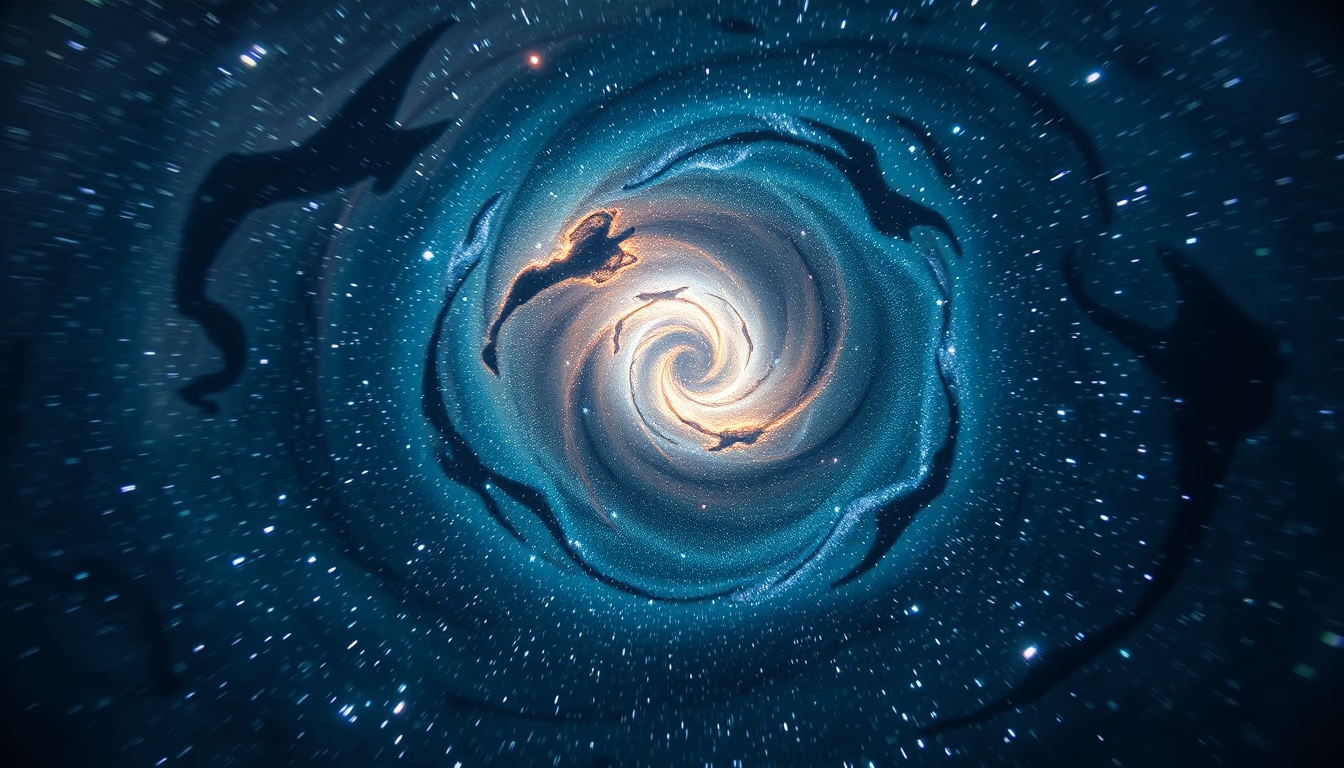
The Andromeda Galaxy (M31) is the largest galaxy in the Local Group, with a spiral disk spanning 220,000 light-years. Visible to the naked eye in the Northern Hemisphere, it is on a collision course with the Milky Way.
About this subject
The Andromeda Galaxy, cataloged as M31 or NGC 224, is a spiral galaxy located approximately 2.5 million light-years from Earth in the constellation Andromeda. It is the most distant object visible to the naked eye, appearing as a faint elongated smudge on moonless nights. With a diameter of about 220,000 light-years, Andromeda is significantly larger than the Milky Way, which spans about 100,000 light-years.
Andromeda is estimated to contain roughly one trillion stars, twice the estimate for the Milky Way. Recent Hubble Space Telescope observations have revealed that the galaxy has a double nucleus, possibly formed by a merger with another smaller galaxy billions of years ago. Its spiral arms are filled with star-forming regions, nebulae, and clusters of young, blue stars.
One of the most fascinating facts about Andromeda is its collision course with the Milky Way. The two galaxies are approaching each other at about 110 km/s, and the merger is expected to occur in approximately 4.5 billion years. The process will form a new giant elliptical galaxy, nicknamed 'Milkdromeda'. Despite the collision, the vast distances between stars make direct stellar collisions extremely rare.
Andromeda is one of the most studied objects by amateur and professional astronomers. On clear nights away from light pollution, it can be observed with binoculars or small telescopes, revealing its bright core and, under good conditions, parts of its spiral arms. The galaxy also hosts the brightest variable star in the night sky, Mirach, and a supermassive black hole at its center with a mass equivalent to 100 million Suns.
Frequently Asked Questions
How far is the Andromeda Galaxy from Earth?
The Andromeda Galaxy is approximately 2.5 million light-years away from Earth.
When will the Milky Way and Andromeda collide?
The collision between the Milky Way and Andromeda is expected to occur in about 4.5 billion years.
Can Andromeda be seen with the naked eye?
Yes, Andromeda is the most distant object visible to the naked eye. On moonless nights away from light pollution, it appears as a faint elongated smudge in the sky.
Direct URL
https://pub-c7d6a6ea828543ac903a74a341ccb2e1.r2.dev/imagens/andromeda-galaxy-spiral-fish-eye-wide-angle-p8.avifHow to credit
Include a visible link back to UtilizAí. Copy one of the snippets below:
<a href="https://xn--utiliza-eza.com/en/midia/imagens/andromeda-galaxy-spiral-fish-eye-wide-angle-p8">Andromeda galaxy spiral</a> by <a href="https://xn--utiliza-eza.com">UtilizAí</a>, licensed under <a href="https://creativecommons.org/licenses/by/4.0/">CC BY 4.0</a>.
[Andromeda galaxy spiral](https://xn--utiliza-eza.com/en/midia/imagens/andromeda-galaxy-spiral-fish-eye-wide-angle-p8) by [UtilizAí](https://xn--utiliza-eza.com), CC BY 4.0
License: CC-BY-4.0