Binary star sunset
1344×768 · AVIF · CC BY 4.0
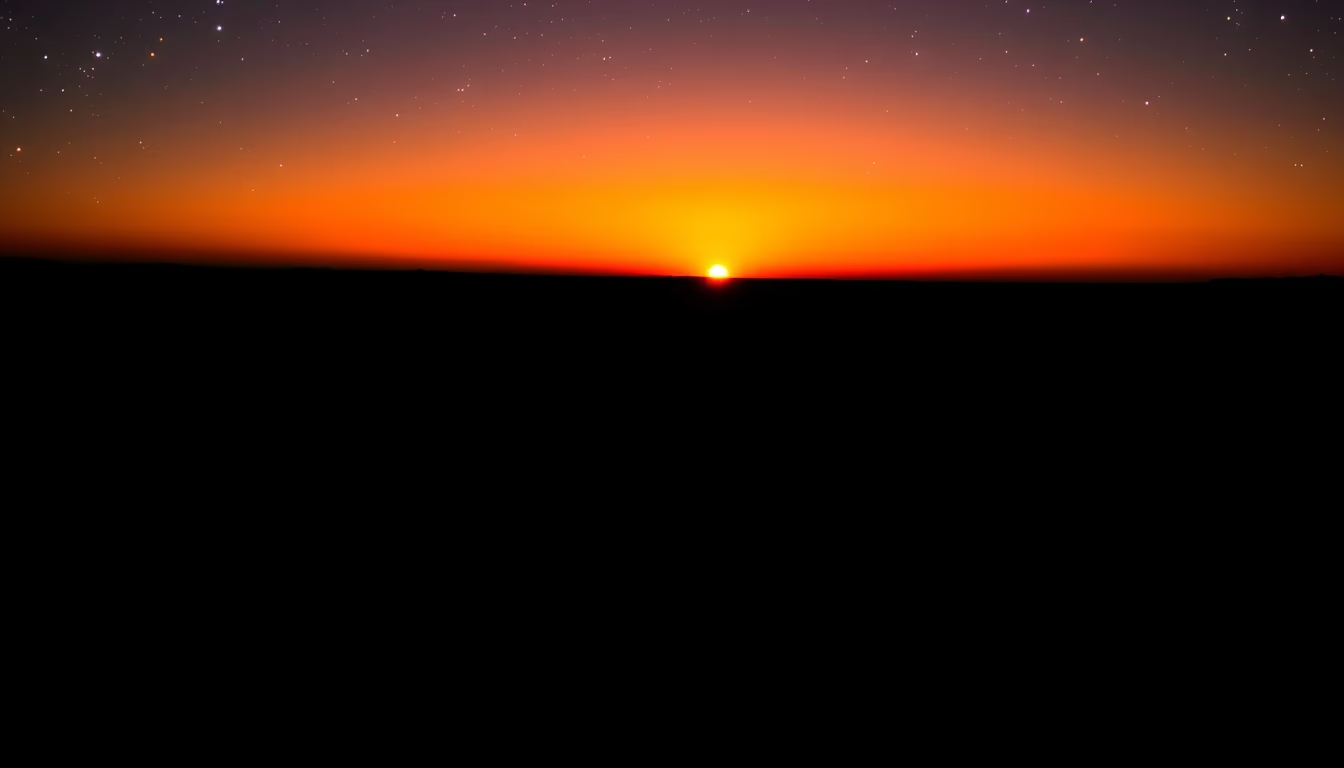
A sunset on a world with two suns, a common phenomenon in binary star systems that fascinates astronomers and inspires science fiction.
About this subject
Binary star systems are the majority in the Milky Way, accounting for about half of Sun-like stars. Planets orbiting these pairs, known as circumbinary planets, have been confirmed by telescopes like Kepler. The most famous example is Kepler-16b, discovered in 2011, which orbits two dwarf stars. On such worlds, sunsets can be double, with the stars setting sequentially or simultaneously, depending on orbital position. Colors vary according to each star's spectral type, potentially producing orange, red, or bluish hues. The visual spectacle is real, not just science fiction, although pop culture, with Star Wars' Tatooine, popularized the image of two suns on the horizon. Astronomers study these planets to understand how they form in complex gravitational environments. About 50% of stellar systems are binary, suggesting exoplanets with two suns may be common in the universe. Observing planetary transits in binary systems is more challenging but has already yielded dozens of candidates. For inhabitants of a circumbinary planet, sunrise and sunset would be an unpredictable and beautiful event, with two stellar discs moving independently across the sky.
Frequently Asked Questions
Is it possible to have life on planets with two suns?
Yes, it is possible, as long as the planet lies in the habitable zone of the binary system. The presence of two stars can stabilize or disrupt orbits, but models indicate that some circumbinary planets could support liquid water.
How many circumbinary planets have been discovered?
As of 2023, about 20 circumbinary planets have been confirmed, such as Kepler-16b, Kepler-34b, and Kepler-35b. The TESS telescope continues to find new candidates.
Why are binary sunsets different from those in a single-star system?
They can occur sequentially or simultaneously, with distinct colors and brightness. The temperature and apparent size of each star vary, creating unique visual effects.
Direct URL
https://pub-c7d6a6ea828543ac903a74a341ccb2e1.r2.dev/imagens/binary-star-sunset-long-exposure-fresh12.avifHow to credit
Include a visible link back to UtilizAí. Copy one of the snippets below:
<a href="https://xn--utiliza-eza.com/en/midia/imagens/binary-star-sunset-long-exposure-fresh12">Binary star sunset</a> by <a href="https://xn--utiliza-eza.com">UtilizAí</a>, licensed under <a href="https://creativecommons.org/licenses/by/4.0/">CC BY 4.0</a>.
[Binary star sunset](https://xn--utiliza-eza.com/en/midia/imagens/binary-star-sunset-long-exposure-fresh12) by [UtilizAí](https://xn--utiliza-eza.com), CC BY 4.0
License: CC-BY-4.0